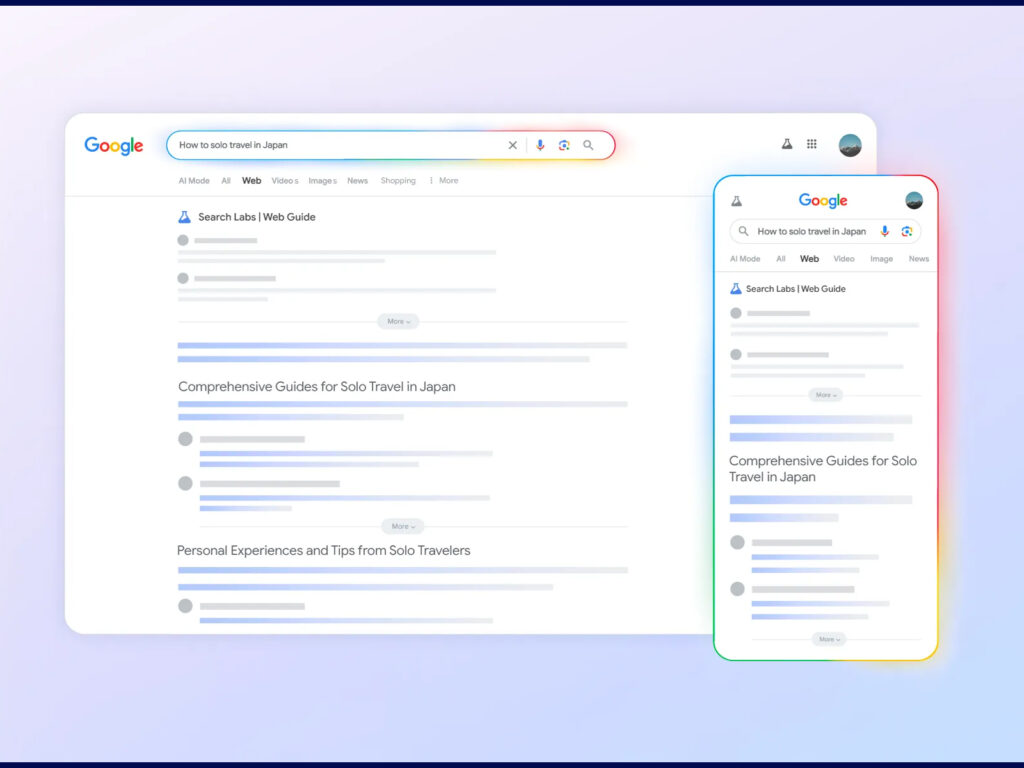
Google has introduced a new AI-based search experiment called 'Web Guide' through its Search Lab. This feature is designed to help users explore information faster and more intuitively, moving away from the simple list of search results of the past.
Web Guides group search results by topic or context. For example, if you search for “How to travel solo in Japan,” Web Guides will organize related websites by topic, such as “Safety tips,” “Budget travel,” and “Regional recommendations.” The results are organized in this way to help users find the topics they are interested in more easily.
The system is based on a customized version of Google’s generative AI model, Gemini, and uses query fan-out, a technique that simultaneously runs multiple related queries on a single question to produce broader and more precise results. It is designed to reach richer and newer information than before.
Google is offering this experiment to opt-in users only on the Web Search tab, with the option to switch back to the regular search results screen at any time. In the future, the experiment will be expanded to include Web Guides in other areas of Search, such as the All tab, to see where AI-driven results are most useful in the search experience.
Web Guides are particularly useful for specific and complex questions. For example, if you type in a sentence like “How to stay in touch with your family when they live across time zones,” you’ll get grouped results with tools and tips that are relevant to your situation. This enhances context-driven searches, rather than just simple keywords.