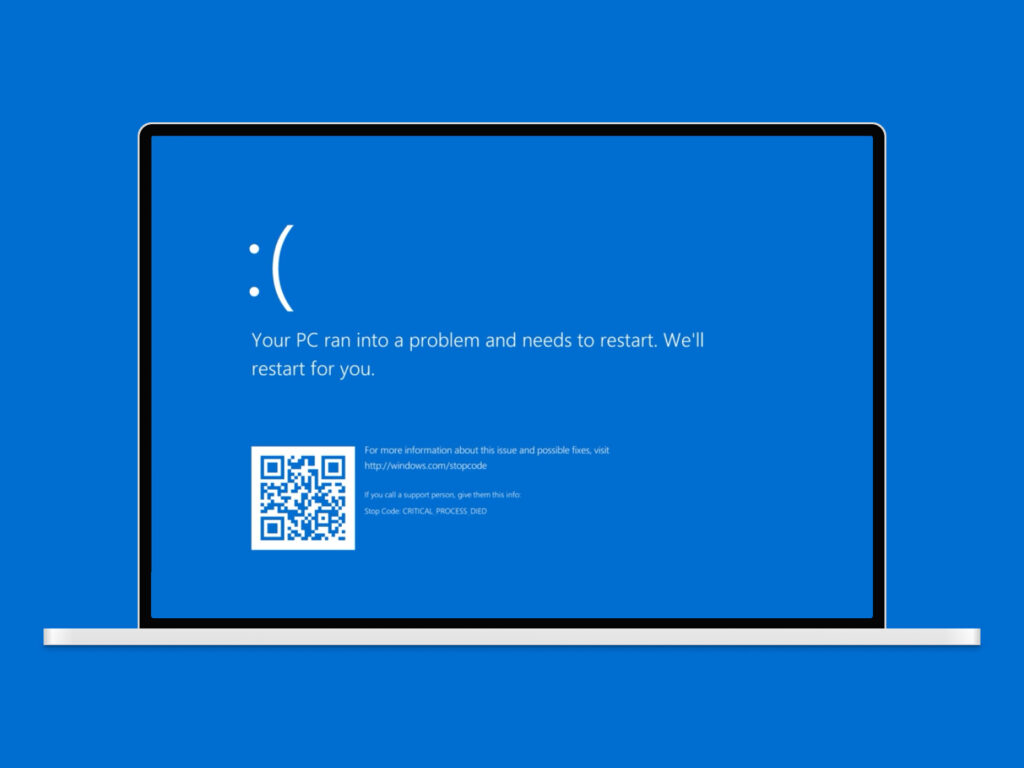
Microsoft will be changing the Windows error screen, commonly known as the 'Blue Screen of Death (BSOD),' to a black screen starting this summer. The blue error screen, which has been an icon of Windows since 1985, will be replaced by the 'Black Screen of Death' starting with Windows 11 version 24H2.
This change is part of Microsoft’s ongoing Windows Resiliency Initiative, and is a revamped security strategy following the CrowdStrike security update incident that shut down approximately 8.5 million Windows devices worldwide in July 2024. At the time, CrowdStrike operated a security sensor by accessing the Windows kernel directly, but an error occurred and caused a large-scale system outage.
Accordingly, Microsoft is restructuring its security programs so that they no longer run in the kernel, but instead in user mode. The new security layer has been developed in collaboration with major security companies such as Bitdefender, CrowdStrike, and ESET, and will be available for preview to some partners starting next month.

The Windows Blue Screen of Death (BSOD) is an error message screen that appears when a fatal error occurs in the system, and it originated in the Windows 1.0 era in the late 1980s. It was in 1993 that the blue-background text screen introduced in Windows 3.1 became widely known to the public, and appeared when an unrecoverable problem such as a system crash or driver error occurred.
From the 1990s to the 2000s, the blue screen continued to be used in various versions such as Windows 95, XP, and 7, and was often recalled as a symbol of an unstable operating system. Later, starting with Windows 8, it was improved to be more user-friendly by adding a frowning emoji and QR code, and in Windows 11, it was temporarily changed to a black screen, but then reverted to blue again.