Amazon has renamed its satellite internet project from "Project Kuiper" to "Amazon Leo." This rebranding appears to be a strategy to clearly define the identity of the low-Earth orbit satellite-based network. Leo, derived from LEO, meaning low-Earth orbit satellite, is a more intuitive name for both consumers and businesses.
Since 2018, Amazon has been building low-Earth orbit satellite internet infrastructure with the goal of bridging the global internet gap. Initially, it was internally codenamed "Project Kuiper," but as it entered the commercial phase, it underwent a rebranding. While the name "Kuiper," referring to the asteroid belt at the edge of the solar system, held technical significance, it felt distant as a consumer network brand.
Amazon has conducted six large-scale launches this year, placing more than 150 satellites into orbit. United Launch Alliance and SpaceX participated in the launches, each conducting three missions. The overall plan involves more than 3,000 satellites and must meet Federal Communications Commission requirements to have at least half of them operational by 2026.
The pace of service preparation is also accelerating. Amazon plans to launch the initial service to select corporate customers later this year and expand to broader geographic coverage starting in 2026. Partners include JetBlue, DirecTV, Sky in Latin America, Brazil, and Australia's national broadband provider NBN.
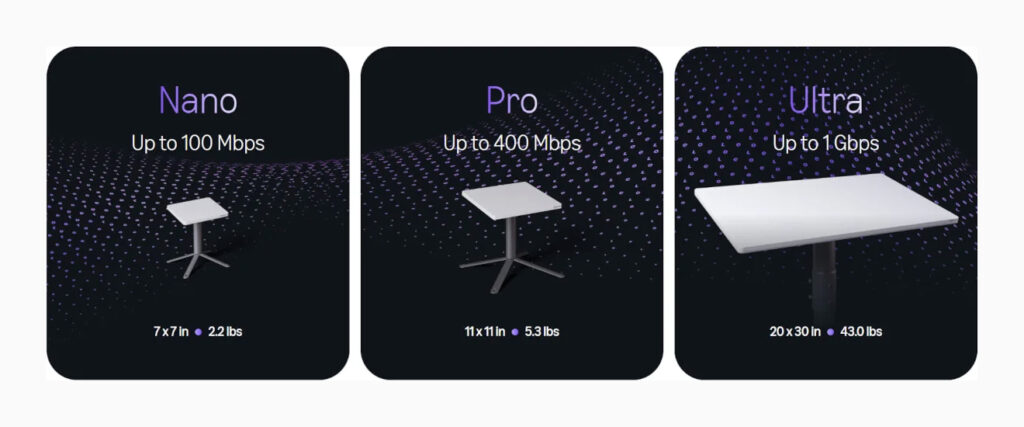
A new hardware lineup has also been unveiled. The Leo Nano is a compact 7-inch device offering download speeds of up to 100 Mbps. The Leo Pro is an 11-inch device supporting up to 400 Mbps, and the Leo Ultra is a larger device designed to reach speeds of up to 1 Gbps. While Amazon hasn't yet announced pricing, the configurations appear to be targeted at both enterprise and consumer devices.
Amazon Leo's key differentiator is its integration with Amazon Web Services. Its strength lies in its ability to integrate satellite networks and cloud infrastructure to create a stable and fast enterprise network environment even in remote areas. This is expected to be a key strategic point in its competition with Starlink, which dominates the existing satellite internet market.
Currently, Starlink operates thousands of satellites and boasts over 8 million users worldwide, but Amazon is catching up with its large-scale production line and new terminal technologies. Accelerating satellite production and diversifying launch partners are likely to be key factors in determining Leo's growth.