The direction of future design has taken shape to some extent. It is to design with AI.
As AI develops, human intervention will decrease. If machines can perform tasks according to established rules and produce consistent results, the need for humans to verify everything manually will also diminish.
However, not all tasks in the world will be completely automated. No matter how much technology advances, there will always be gaps where human judgment and intervention are required. And I believe that is where the role of design will become even more important.
The most important thing in design is always humans. This is because design is ultimately an act of satisfying humans.
No matter how perfectly technology performs a task, it is humans who accept the results. It is difficult for AI to judge on behalf of humans what they feel comfortable with, what they trust, and what experiences provide them with satisfaction.
Then, what kind of designer will be needed in the future?.
First, I believe the capability that will remain unchanged over the long term is product design capability that helps people use AI more effectively.
We are currently transitioning from an era of making mobile devices useful to an era of making AI useful. However, achieving desired results with AI is still challenging. Making AI easier and more convenient for non-experts to use will remain a significant task for quite some time to come.
The next most important thing is the ability to design with AI.
AI-powered design technology is growing rapidly. While the pace of change has been fast so far, it will accelerate even further in the future. As you learn new technologies, there are times when you may wonder, "Is it still worth learning this?" because AI handles so many tasks automatically and efficiently.
However, that does not mean learning loses its meaning.
You can understand this by recalling the experience of moving from Photoshop to Sketch, and then to Figma. Those who understood and used the previous tool well were able to learn the next one more quickly. The tools change, but the fundamental context of handling design remains the same.
The same will likely apply to AI. While technology will continue to evolve, the mindset and workflow required to produce good results remain crucial. Moving forward, it is necessary to establish a structure where overall quality improves alongside AI advancement, and to implement methods for continuously updating new information.
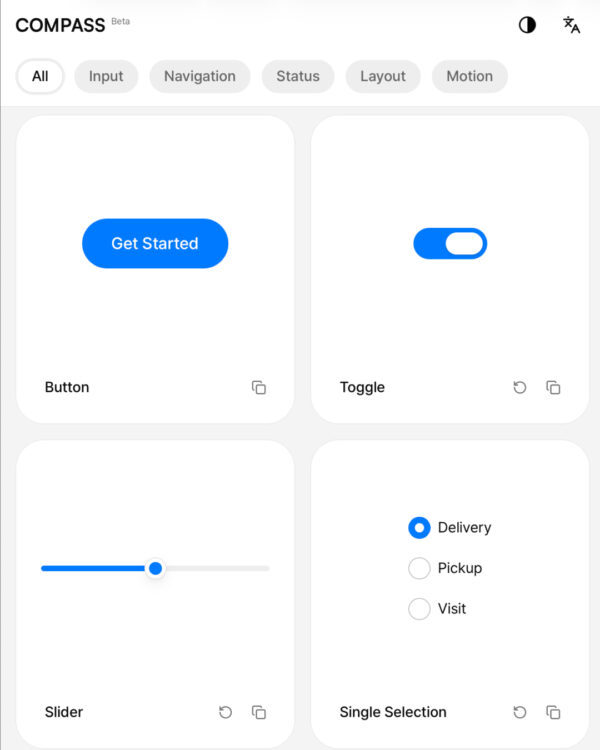
Going forward, we plan to develop Design Compass's activities around two main directions.
One is a design that helps people use AI more comfortably. The other is a method for designers to create better designs using AI.
I will conduct my own research and experiments, but no one yet has a clear answer to this topic. Therefore, rather than declaring a definitive answer, I intend to move forward in a direction of collaborative exploration.
The unchanging essence of design remains important. At the same time, the ability to adapt to a rapidly changing era has also become crucial. While we have discussed the essence of design extensively so far, going forward, we intend to cover methods for adapting to change as well.
I will convey the essence with a long breath, and the changes with a fast breath.