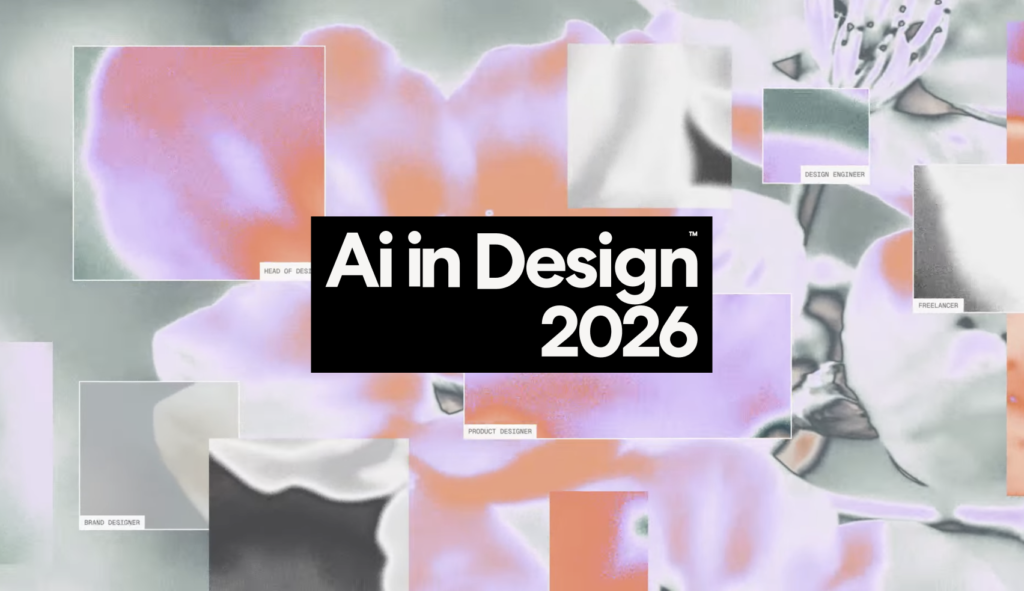
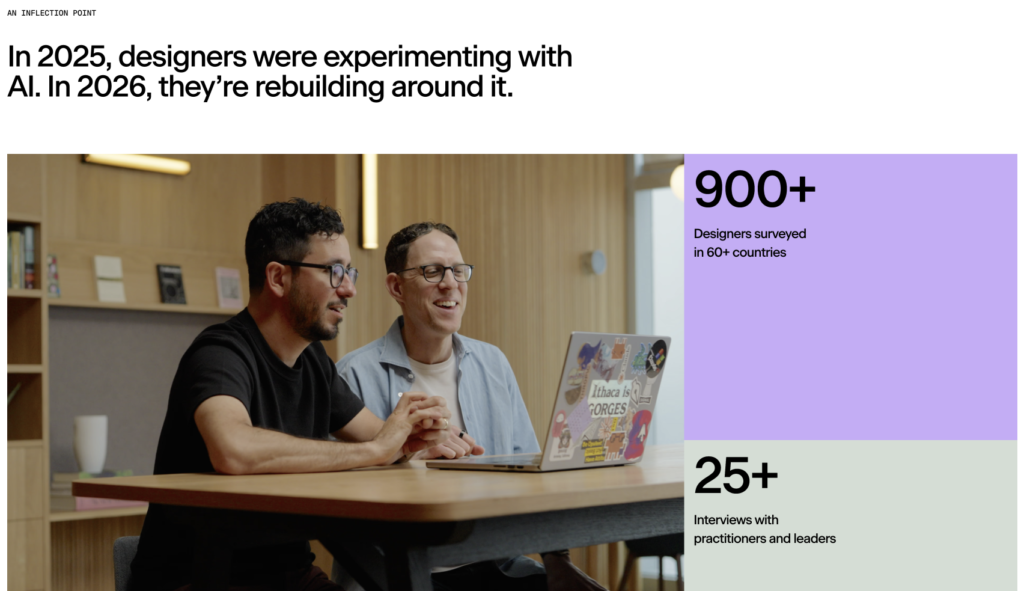
Designer Fund and Foundation Capital have released the AI in Design Report 2026. This report is based on a survey conducted in March 2026 with 906 designers working in over 60 countries. 60% of the respondents are designers with more than 10 years of experience. However, the report explains that since the sample may have included a higher proportion of designers and organizations that have actively embraced AI, it should be interpreted as a direction rather than an absolute standard.
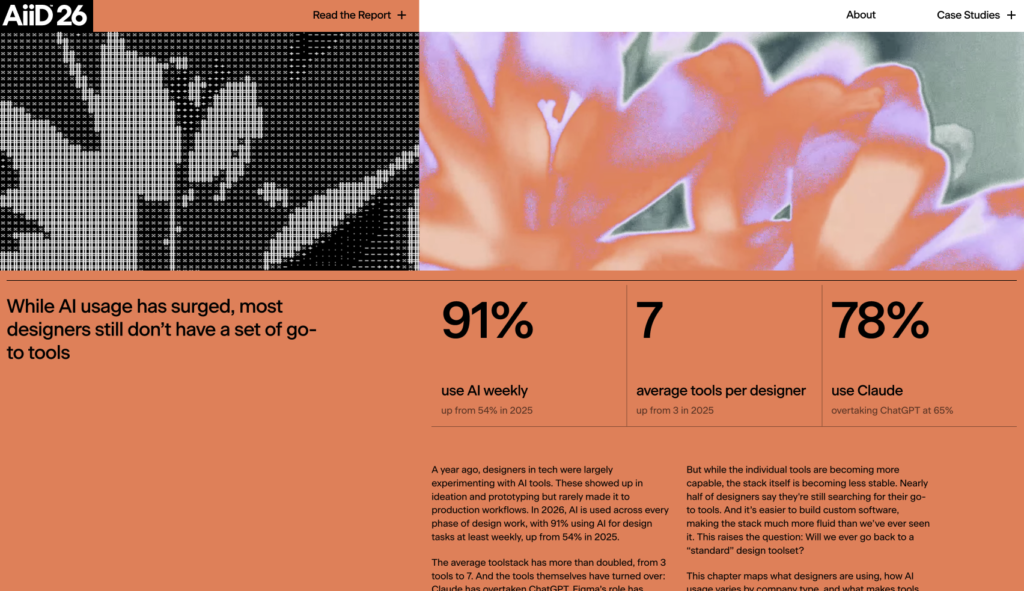
The most significant change in the report is the frequency of AI usage. The number of respondents using AI at least once a week in their design work increased from 541 TP3T in 2025 to 911 TP3T in 2026. The number of designers using AI daily also reached 751 TP3T. AI is no longer just an experimental tool for a select few designers. It is being integrated throughout the entire design process, ranging from idea generation, prototyping, UI copying, research organization, documentation, code generation, design QA, and developer handoffs.
The tool landscape is also changing rapidly. The average number of AI tools used by a single designer increased from three in 2025 to seven in 2026. The most frequently used tools have also shifted. According to the report, Claude's usage rate reached 781 TP3T, surpassing ChatGPT's 651 TP3T. However, a standard tool set has not yet been established. The report analyzes that many designers are still searching for the tool combinations that suit them, and the AI tool stack has become more fluid.
The biggest challenge is output quality. While AI tools can generate results quickly, those results are not always reliable. The report explains that although the increased use of AI has enabled designers to create more mockups and experiment more rapidly, stable, high-quality output remains an area that requires improvement.
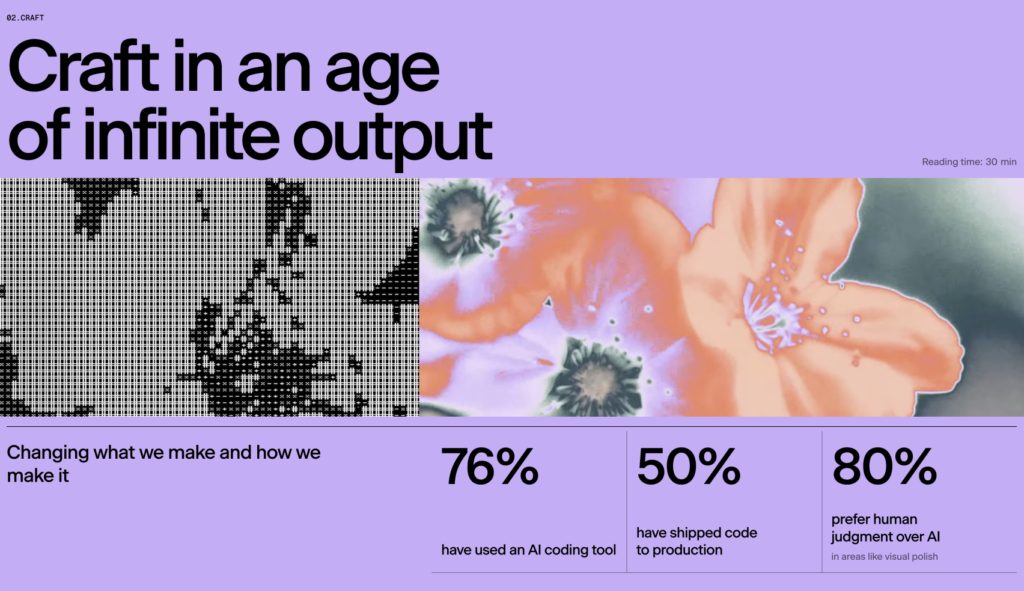
Coding is also becoming more deeply integrated into design work. The report explains that thanks to AI, designers are able to create prototypes more quickly and handle deliverables that are close to implementation. Half of the respondents stated that they have experience deploying AI-generated code to a production environment. This signals that the role of designers is expanding beyond screen design to validate ideas into working forms.
However, this does not mean that design judgment has been completely handed over to AI. Approximately 801 TP3T of respondents stated that they still rely on their own judgment for quality assessment, final visual completeness, and creative direction. Designers ranging from 60 to 701 TP3T also viewed human judgment as important for understanding user needs, defining problems, storytelling, systems thinking, and designing structural frameworks.
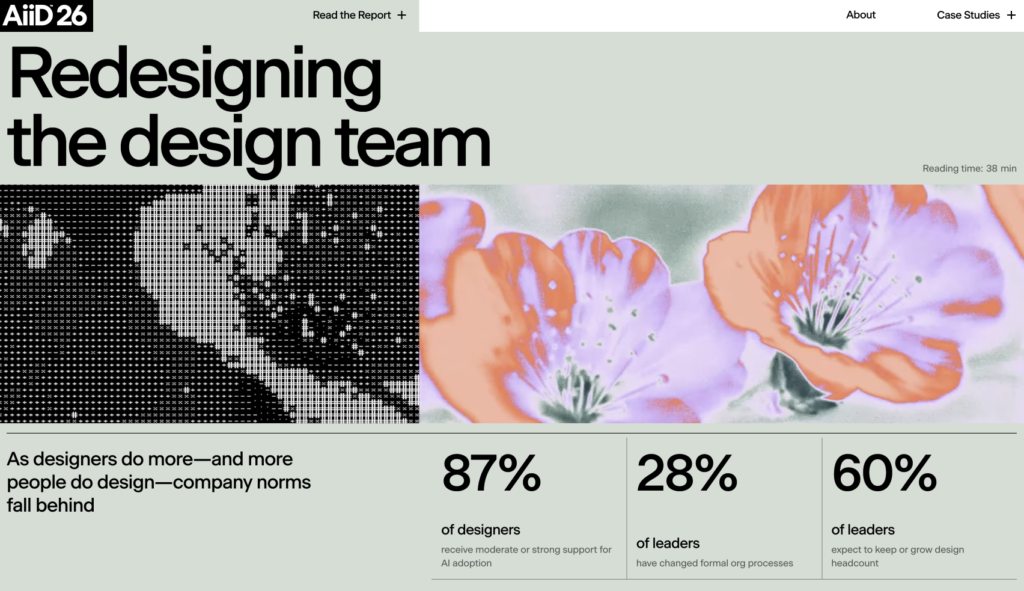
Organizational change lags behind work change. While the use of AI is spreading rapidly, formal processes such as evaluation systems, hiring criteria, and team management methods have not yet changed sufficiently. This gap is likely to become a key challenge that design leaders will have to address in the future. Individuals using tools are changing quickly, but organizations must create new standards and structures to keep up with that pace.
The changes presented in this report are far from the simplistic notion that “AI will replace designers.” A more immediate change is that the scope required of designers is expanding. In the future, designers will find it difficult to remain merely as people who make screens look pretty. Their roles are becoming increasingly important, as they determine what needs to be created, combine AI outputs, verify with prototypes, and take responsibility for final quality.
More and Sources