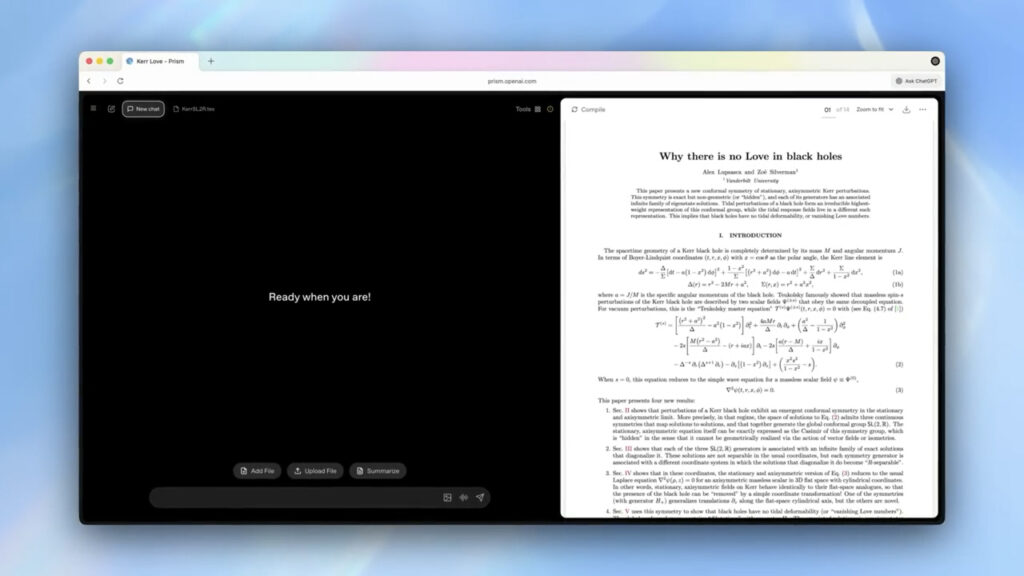
OpenAI has released Prism, a free AI workspace for scientists. Prism integrates ChatGPT into the LaTeX editor, a widely used tool for writing papers, allowing researchers to receive AI assistance right from the start. MIT Technology Review compared this to the trend of adding chatbots to coding editors to boost productivity, describing it as akin to Vibe Coding in the scientific field.
Kevin Weil, who leads OpenAI for Science, said in a briefing that 2026 could be a significant turning point for AI in science. He noted that the changes AI brought to software engineering in 2025 could be replicated in science in 2026. OpenAI explained that scientists worldwide send over 8 million queries per week to ChatGPT on advanced science and math topics, with 1.3 million users. The company believes this usage is a sign that it's moving beyond curiosity and into core workflows.
Prism appears to be a strategy to capitalize on this demand with its documentation tool. Some interpret this as an attempt to lock researchers into its ecosystem amidst the proliferation of competing chatbots. Indeed, biologist Roland Dunbrack said he primarily uses GPT-5 for code writing and for asking scientific questions to quickly find literature. Statistician Nikita Zybotowski has reported that GPT-5 helps refine sentences in research papers, detect mathematical typos and bugs, and even provides useful summaries.
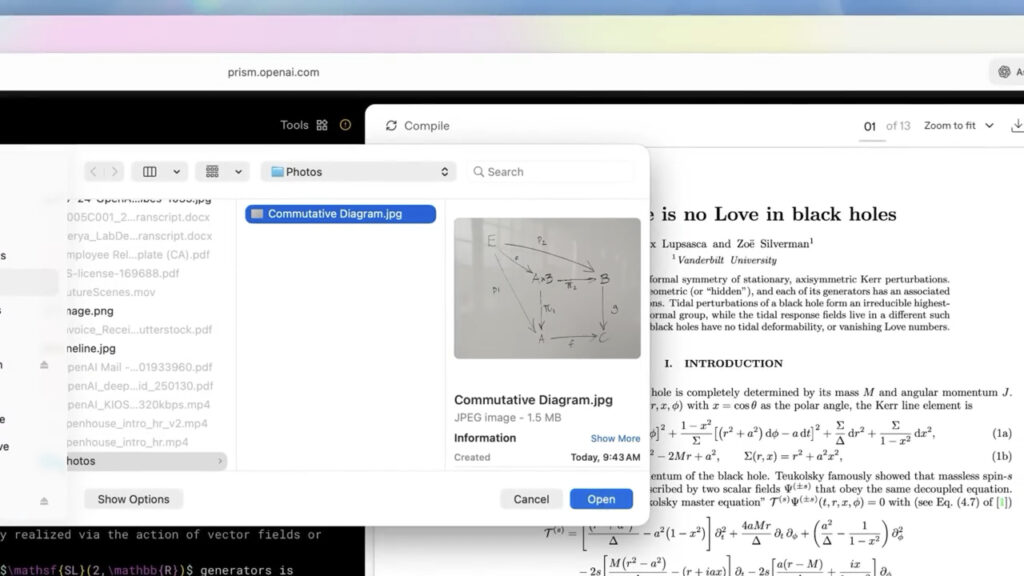
The product features are practical. Users can receive drafting assistance in a chat window attached to the bottom of a document, summarize related papers, and manage citations. It also supports converting whiteboard photos into equations or diagrams. It also includes a flow for checking hypotheses and proofs through dialogue. OpenAI has announced that GPT-5.2, the most powerful model for solving mathematical and scientific problems, will be integrated into Prism's core engine.
However, expectations and concerns are also being raised. There are ongoing concerns that low-quality AI-generated content could flood the academic world. Weil emphasized that he doesn't aim for a fully automated scientist right away. He stated that AI will accelerate research by accumulating numerous small improvements rather than producing a single, iconic discovery. Prism is described as an early step toward reducing repetitive tasks in paper writing and collaboration, allowing researchers to focus more on discovery.